
 3 weeks ago
10
3 weeks ago
10

Ethereum (ETH) is struggling to build momentum near $2,700 as rising exchange balances and weaker institutional inflows point to more cautious positioning.
Profit-taking has accompanied the recent consolidation, while investors await US inflation and labor market releases scheduled for Wednesday and Friday.
Geopolitical uncertainty is adding pressure, leaving ETH in need of a fresh catalyst to extend its advance.
Despite those headwinds, Ethereum’s daily chart remains constructive.
The asset continues trading above its key exponential moving averages, although buyers have yet to overcome nearby resistance.
Rising exchange reserves signal potential selling pressure
Ethereum exchange reserves have increased by roughly 125,000 ETH since Friday, according to CryptoQuant data.
The metric tracks ETH held in exchange wallets. Rising reserves can indicate that holders are preparing to sell, particularly after a price recovery, although deposits alone do not establish that those tokens have been sold.
Santiment data also showed more than $222 million in realized profits on Friday.
Profit-taking subsequently eased, suggesting that selling activity has moderated from that peak.
US market sentiment has weakened alongside those flows.
The Coinbase Premium Index fell to -0.0483, its lowest reading in nearly two weeks, after recovering modestly last week.
The negative reading points to relatively weaker pricing on Coinbase compared with the index’s reference market, reinforcing the picture of softer US buying demand.
US spot Ethereum ETFs have also shown signs of weakening demand, with inflows on Monday followed by a small net outflow on Tuesday.
CoinGlass data showed $17.1 million in net inflows on Monday and a net outflow of $2.80 million on Tuesday.
The outflow suggests that institutional demand is providing less immediate support.
Investors may be reducing exposure ahead of upcoming US inflation and labor market data.
Those releases could influence expectations for interest rates and appetite for risk assets.
Geopolitical developments are also weighing on sentiment. US-Iran peace talks remain stalled after President Donald Trump rejected Iran’s ceasefire proposal.
Meanwhile, the US 10-year Treasury yield has risen by approximately 70 basis points over the month.
Higher yields and expectations of tighter monetary policy can make conditions more challenging for cryptocurrencies, particularly when investors are already taking profits.
Ethereum’s technical structure remains constructive
ETH traders also saw $56.64 million in liquidations over the past 24 hours, including $32.24 million in short positions, highlighting elevated volatility around the current price range
The larger short-liquidation total shows that traders betting against ETH also faced pressure during the period.
On the daily chart, ETH remains above its key exponential moving averages, preserving a bullish near-term structure.
The Relative Strength Index stands at 61, while the Stochastic oscillator is around 71.
Both readings remain constructive, although neither guarantees that price will break higher.
Immediate support lies between $2,612 and $2,626, combining the 20-day EMA with a nearby horizontal level.
A break below that area would bring $2,544 into focus, followed by the previous consolidation floor near $2,431.
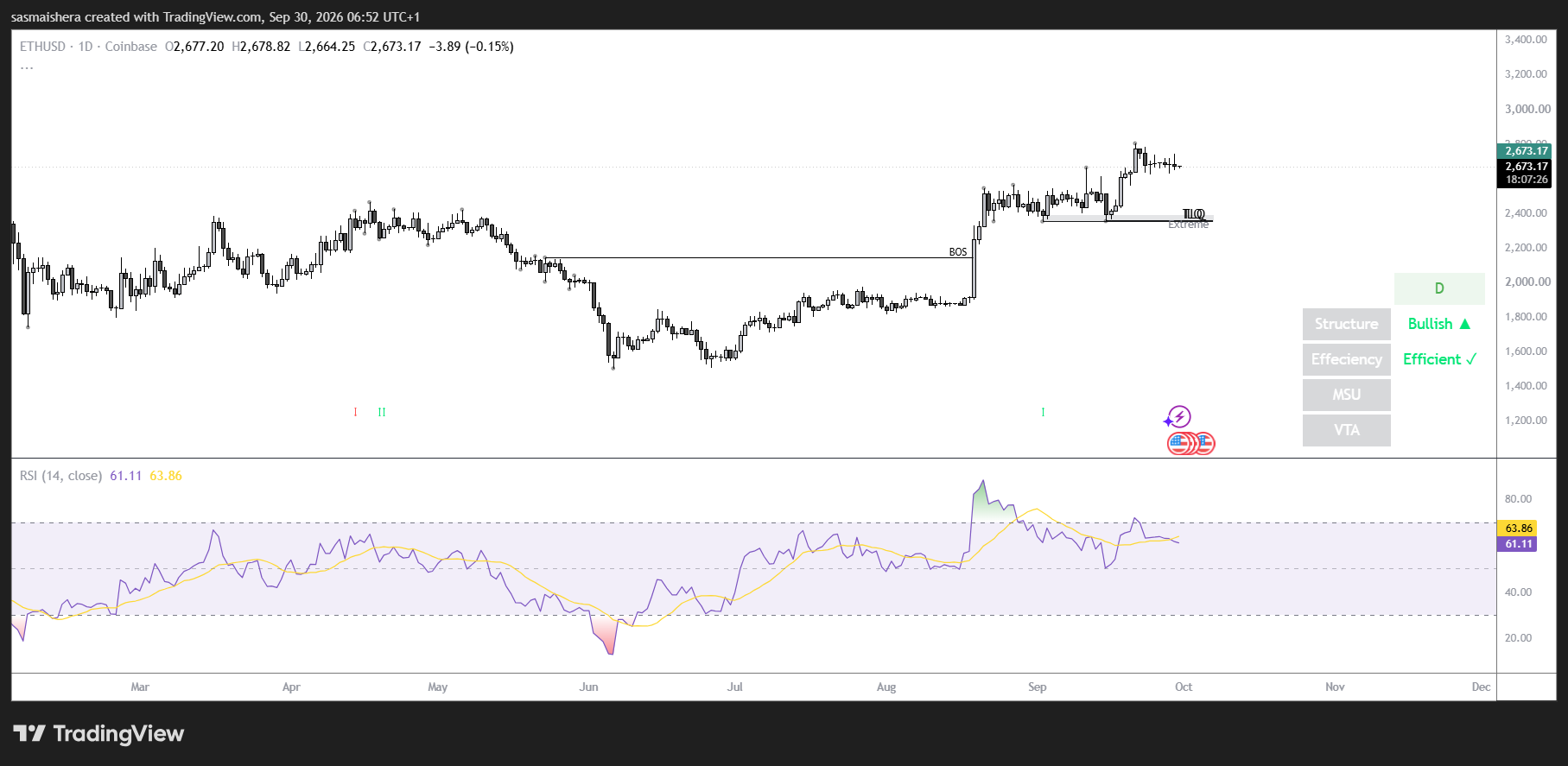
A deeper decline could expose the 100-day EMA around $2,275, with additional support at $2,172 and $1,961.
Ethereum’s first major upside hurdle is $2,786. A daily close above that level would strengthen the case for a move toward $2,894 and potentially $3,177.
Until buyers clear resistance, consolidation remains the prevailing pattern.
Stronger ETF inflows or favorable economic data could support a breakout, while renewed exchange selling and rising yields could push ETH toward its nearby support zone.
The post Ethereum stays below $2,700 as profit-taking rises and ETF inflows slow appeared first on Invezz













 English (US) ·